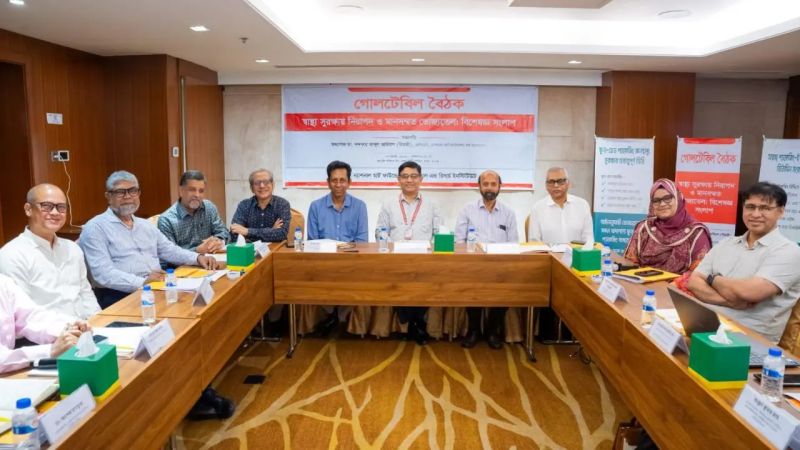
On Tuesday, July 7, 2026, a roundtable discussion titled “Safe and Quality Edible Oil for Health Protection: Expert Dialogue” was held at the conference room of Hotel Holiday Inn in Dhaka, organized by the National Heart Foundation of Bangladesh. I had the honor of moderating the session. (Mustak Iftekhar)
The dialogue brought together academics, scientists, researchers, representatives from oil refineries, regulatory agencies, and policymakers.
Professor Moloy Kanti Mridha of BRAC University noted that while household dependence on loose (unpackaged) edible oil has decreased—now affecting about 49% of families—its use has increased in the food processing industry and in hotels and restaurants.
Public health experts stressed the importance of ensuring safe, high-quality, vitamin A–fortified edible oil across the entire supply chain—from crude oil imports to retail sales. They urged the adoption of opaque, food-grade packaging instead of transparent containers, to preserve the vitamin A content.
Professor Liaquat Ali, Chairman of Pathikrit Foundation and former Vice-chencellor, explained that different types of oils have different effects on human health. He emphasized that lifestyle, diet, and cultural changes all play a major role in public health, and more research is needed in this area.
Mr. Sultan Alam, Joint Secretary of the Ministry of Industries, pointed out that many DO (delivery order) dealers still transport edible oil in chemical drums, and there is no effective system to detect this. He said that stopping the use of such drums would improve product quality.
At the end of the discussion, several recommendations were made:
Strengthen coordination between refineries and regulators to ensure 100% opaque, food-grade packaging.
Make it mandatory to display a “Food-Grade” symbol on oil packets.
Control the use of loose oil in food processing industries, hotels, and restaurants by issuing and SRO under Section 8 of the Vitamin A Fortification in Edible Oil Act, 2013.
Require heavy metal testing at ports during crude oil imports.
Among others, the event was attended by:
Brigadier General (Retd.) Professor Md. Yunusur Rahman, Director, National Heart Foundation of Bangladesh
Professor Dr. Sohel Reza Choudhury, Head of Epidemiology & Research, National Heart Foundation Hospital & Research Institute
Mr. Kutubul Alam, Senior General Manager, Meghna Group of Industries
Mr. Mohammad Shahidul Islam, GM (QC, QA & Compliance), TK Group
Mr. S. M. Abu Sayeed, Deputy Director, Bangladesh Standards and Testing Institution (BSTI)
Mr. Khandker Raqibul Islam Secretary, FEAB-Food Engineers Association, Bangladesh, Professor Dr. Md. Saidul Arefin, Director, Institute of Nutrition and Food Science, University of Dhaka and other distinguished participants.

Global Technical Experts Network